I’m a castle geek. There I’ve said it.
You can lose your mind in Osaka. It’s a city designed for glorious, manic excess, a neon-drenched labyrinth of sizzling street food and beautiful chaos. You can spend days mainlining takoyaki in the electric veins of Dotonbori and think you’ve seen it all. But you’d be dead wrong. Because just a stone’s throw from the glorious madness, there’s another kind of power at play. A heavier, quieter, and infinitely more brutal kind of power. It rises from the earth in a defiant snarl of stone and water: Osaka Castle.
This is no fairy-tale fortress. This is a statement. A monument to the kind of ambition that carves history out of sheer rock and will. To approach it is to feel the modern world recede, to step through a veil into an era of shoguns, sieges, and the savage poetry of war.
The Great Wall and the Emerald Moat
The first thing that hits you is the sheer, lunatic scale of the defenses. You don’t just walk up to this place; you are swallowed by it. The castle is surrounded by a massive, emerald-green moat, a silent, stagnant body of water that looks deep enough to drown an army. And rising from that water are the walls.
Forget everything you know about walls. These are not walls; these are cliffs. Gigantic, monolithic blocks of granite, some the size of small cars, are stacked with a precision that seems to defy both gravity and the tools of the 16th century. These stones were dragged here from over a hundred kilometers away by legions of men, a testament to the raw, feudal power of Toyotomi Hideyoshi, the great unifier who first willed this fortress into existence. You walk along the edge of the moat, dwarfed by the sheer verticality of it all, and you realize this wasn’t just built to keep people out; it was built to crush the spirit of anyone who dared to approach with ill intent.
A Fortress Within a Fortress
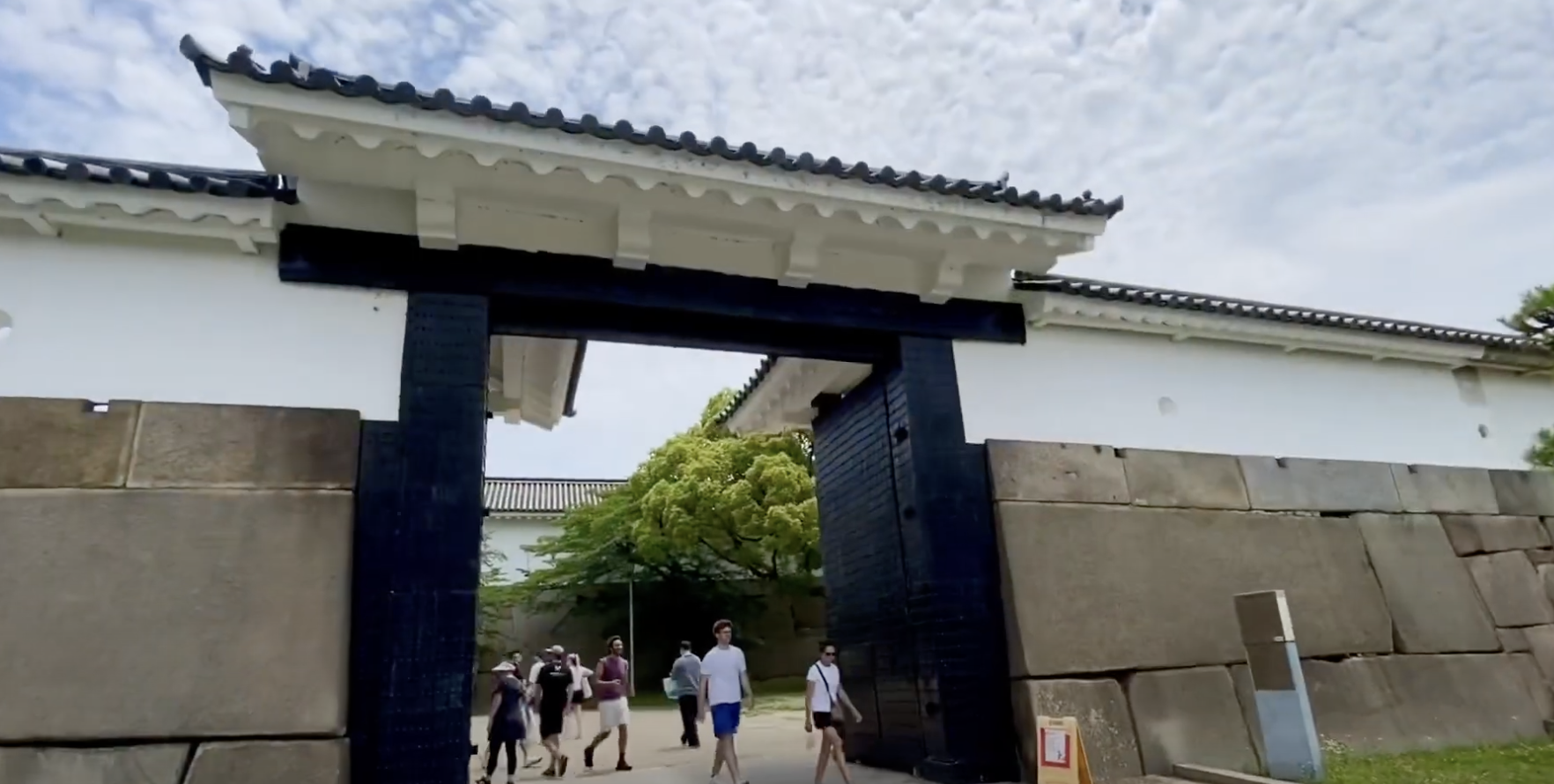
Crossing the bridge and passing through the colossal, iron-studded Otemon Gate is like entering another dimension. The noise of the city dies, replaced by the crunch of gravel underfoot and the rustle of leaves in ancient trees. The grounds are a sprawling oasis, a deceptive calm before the main event. You’re not in the castle yet; you’re just in the first line of defense.
You snake your way through inner walls and past imposing turrets, each one a strategic masterpiece designed for slaughter. The path is a kill box, forcing any invading army into a series of choke points where they would be met with a rain of arrows and lead shot. It’s a beautiful, serene walk today, but the ghosts of its violent past are everywhere, etched into the very stones you walk upon.
The Towering Phoenix
And then you see it. Rising above the final wall, a magnificent, five-story tower crowned with a flourish of green copper tiles and golden ornamentation. This is the main keep of Osaka Castle. Now, a purist might tell you it’s a fake, a concrete reconstruction from 1931. And they’d be right. The original was struck by lightning and burned to the ground centuries ago.
But to get hung up on authenticity is to miss the point entirely. This tower is a symbol of Osaka’s defiant, unbreakable spirit. It’s a city that has been burned, bombed, and flattened time and again, and every time it rises from the ashes, bigger and bolder than before. The castle keep is a concrete phoenix, a 20th-century tribute to a 16th-century dream, and it is no less spectacular for it. It stands against the modern skyline, a proud anchor in the swirling currents of time.
From its highest floor, you get a god’s-eye view of the whole magnificent spectacle. Below you are the sprawling castle grounds, a green island of history. And beyond, stretching to the horizon in every direction, is the endless, pulsating grid of modern Osaka. It’s a breathtaking collision of worlds, the ancient and the hyper-modern, and you’re standing right at the point where they slam into each other. It’s a view that will rewire your brain.